Pipe welding rod types are fundamental to the integrity and safety of countless industrial applications, ranging from oil and gas pipelines to structural engineering. Understanding the nuances of these rods – their composition, characteristics, and appropriate uses – is critical for ensuring robust and reliable welded joints. The global demand for efficient and durable infrastructure directly translates to a consistent need for high-quality pipe welding rod types, making their selection and implementation a crucial aspect of modern industry.
The economic impact of pipe welding is substantial, with billions of dollars spent annually on materials and labor. Failures in pipelines or structures due to inadequate welding practices can lead to catastrophic consequences, including environmental damage, economic losses, and even loss of life. Therefore, selecting the right pipe welding rod types is not merely a technical decision but a responsibility impacting safety and sustainability.
Proper knowledge of pipe welding rod types enables engineers, welders, and inspectors to optimize welding processes, reduce costs, and enhance the lifespan of critical infrastructure. It also facilitates compliance with stringent industry standards and regulations, ensuring projects meet the highest safety and performance benchmarks.
The Importance of Pipe Welding Rod Types
The choice of pipe welding rod types directly impacts the structural integrity of any welded joint. Different materials require different rod compositions to achieve optimal strength, ductility, and corrosion resistance. Improper selection can lead to weld defects, premature failure, and costly repairs. This is why a thorough understanding of available options is critical.
Furthermore, regulatory bodies across the globe, such as the American Welding Society (AWS) and ISO, maintain stringent standards for welding procedures and materials, including specific requirements for pipe welding rod types based on the application and the materials being joined. Adherence to these standards is essential for ensuring safety and compliance.
Defining Pipe Welding Rod Types
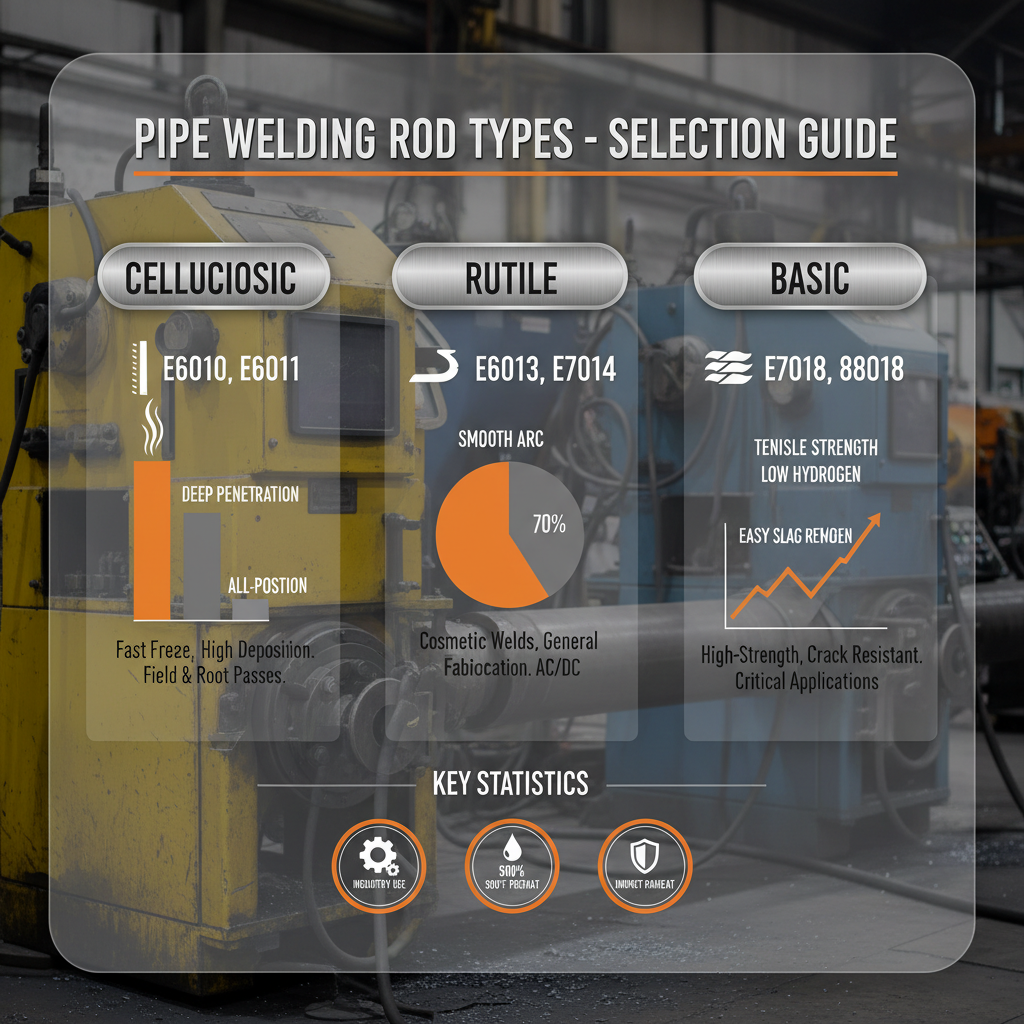
Pipe welding rod types, often referred to as welding electrodes, are consumable materials used to join metal pieces through the welding process. They provide the filler metal that fuses with the base metals, creating a strong and durable bond. These rods are classified based on their composition, coating, and intended application. pipe welding rod types come in various forms, including shielded metal arc welding (SMAW) rods, gas metal arc welding (GMAW) wires, and flux-cored arc welding (FCAW) wires.
The coating on a welding rod plays a vital role in shielding the weld pool from atmospheric contamination, stabilizing the arc, and influencing the mechanical properties of the weld. Different coatings are designed for specific metals and welding positions. Understanding these nuances is crucial for achieving high-quality welds.
In essence, pipe welding rod types serve as the conduit for creating a metallurgical bond between two or more metal pieces, providing structural support and ensuring the integrity of the welded assembly. Their selection is determined by factors like the type of metal being welded, the welding process employed, and the desired properties of the final weld.
Core Characteristics of Pipe Welding Rod Types
Several key characteristics define the quality and suitability of pipe welding rod types. These include tensile strength, yield strength, elongation, and impact toughness. Tensile strength measures the rod's resistance to being pulled apart, while yield strength indicates its resistance to permanent deformation. Elongation reflects the rod’s ductility, and impact toughness determines its ability to withstand sudden shocks.
Another critical factor is the rod’s chemical composition. Different alloys contain varying percentages of elements like carbon, manganese, silicon, and chromium, which significantly impact the weld’s properties. For example, low-alloy steel rods offer increased strength and toughness, while stainless steel rods provide excellent corrosion resistance. Careful consideration of these compositions is crucial for matching the rod to the base metal.
Finally, the coating type profoundly affects the welding process and the weld quality. Coatings can provide shielding gas, deoxidizers, and alloying elements, influencing arc stability, slag formation, and the final weld’s mechanical properties. Different coatings are optimized for specific welding positions and base metal types.
Key Factors Influencing Rod Selection
Selecting the appropriate pipe welding rod types requires careful consideration of several key factors. The type of base metal being welded is paramount. Different metals require rods with compatible compositions to ensure proper fusion and avoid weld defects. Material compatibility is absolutely crucial.
The welding process itself plays a significant role. SMAW, GMAW, and FCAW each have specific rod requirements. For example, SMAW typically uses covered electrodes, while GMAW utilizes continuous wires. The welding position (flat, horizontal, vertical, overhead) also influences rod selection, as some rods are better suited for certain positions than others.
Pipe Welding Rod Types Performance Comparison
Global Applications of Pipe Welding Rod Types
Pipe welding rod types are integral to a vast range of global industries. In the oil and gas sector, they’re critical for constructing and maintaining pipelines that transport vital energy resources across continents. Similarly, the construction industry relies heavily on these rods for building bridges, skyscrapers, and other large-scale structures.
The chemical processing industry utilizes specialized pipe welding rod types that can withstand corrosive environments. Furthermore, in post-disaster relief operations, pipe welding rod types are essential for repairing damaged infrastructure and establishing temporary water and sanitation systems. In remote industrial zones, like arctic oil rigs, specialized low-temperature rods are vital for maintaining operational integrity.
Advantages and Long-Term Value
The advantages of selecting high-quality pipe welding rod types extend beyond immediate weld integrity. Cost savings through reduced rework and maintenance are significant. Durable welds translate to extended asset lifecycles, minimizing long-term expenses. Furthermore, the use of appropriate rods enhances safety by reducing the risk of structural failures.
Investing in superior pipe welding rod types fosters trust and reliability in engineered systems. This translates into increased customer satisfaction and a stronger reputation for companies involved in construction, infrastructure development, and manufacturing. Sustainable practices are also supported through reduced material waste and longer-lasting structures.
Future Trends and Innovations
The field of pipe welding rod types is constantly evolving. Research is focused on developing rods with improved mechanical properties, enhanced corrosion resistance, and reduced environmental impact. Automation and robotic welding are driving the demand for rods optimized for these processes, requiring consistent and reliable performance.
Green energy initiatives are also influencing rod development. Materials designed for welding wind turbine towers and other renewable energy infrastructure must withstand extreme weather conditions and ensure long-term durability. Digital technologies, such as AI-powered welding parameter optimization, are being integrated to further refine rod selection and welding procedures.
The shift towards sustainable manufacturing is driving the development of eco-friendly welding rods, utilizing recycled materials and reducing harmful emissions. These innovations promise to enhance efficiency, reduce costs, and minimize the environmental footprint of welding operations.
Overview of Pipe Welding Rod Types Performance Metrics
| Rod Type |
Tensile Strength (MPa) |
Corrosion Resistance (1-10) |
Cost per Kilogram ($) |
| E7018 (Low Hydrogen) |
570 |
6 |
2.50 |
| E308L (Stainless Steel) |
550 |
9 |
5.00 |
| E6010 (Cellulosic) |
480 |
4 |
1.80 |
| E7014 (Iron Powder) |
530 |
5 |
2.20 |
| ER70S-6 (GMAW Wire) |
560 |
6 |
3.00 |
| Flux Cored (E71T-1) |
580 |
7 |
3.50 |
FAQS
E7018 rods are low-hydrogen, all-position rods providing excellent weld quality and ductility, making them suitable for critical applications. E6010 rods are cellulosic, offering deep penetration and are often used for root passes in pipelines. E6010 requires a more skilled welder due to its fast freezing slag, whereas E7018 is more forgiving. Selecting the correct rod is crucial for weld integrity and safety.
Choosing the right rod for stainless steel requires careful consideration of the alloy being welded. E308L is a common choice for many stainless steel grades, providing good corrosion resistance and weldability. However, for specialized stainless steel alloys like duplex stainless steels, specific matching rods are necessary to maintain corrosion resistance and mechanical properties. Always consult material specifications.
Low hydrogen welding rods, like E7018, are manufactured with coatings that minimize the introduction of hydrogen into the weld pool. Hydrogen can cause hydrogen-induced cracking, a serious weld defect. Using low-hydrogen rods is particularly important for welding high-strength steels and critical applications where weld integrity is paramount. Proper storage of these rods is also critical to prevent moisture absorption.
The coating on a welding rod serves multiple purposes. It shields the weld pool from atmospheric contamination (oxygen, nitrogen, hydrogen), provides alloying elements to enhance weld properties, stabilizes the arc, and controls the slag formation. Different coatings are designed for specific welding processes, base metals, and welding positions, impacting the overall weld quality.
Welding rods, especially low-hydrogen types, should be stored in a dry, sealed container to prevent moisture absorption. Moisture can lead to hydrogen-induced cracking and reduced weld quality. If rods become damp, they should be baked at the manufacturer's recommended temperature to remove the moisture before use. Proper storage is essential for maintaining the integrity of the welding rods.
SMAW (Shielded Metal Arc Welding) utilizes covered electrodes, offering versatility and portability. GMAW (Gas Metal Arc Welding) uses continuous wire feed and requires shielding gas. FCAW (Flux-Cored Arc Welding) employs tubular wire with a flux core for shielding and alloying. Each process requires specific rod compositions and characteristics to achieve optimal weld quality. SMAW rods are often used for maintenance and repair, while GMAW and FCAW are common in production welding.
Conclusion
Understanding pipe welding rod types is paramount for ensuring the safety, reliability, and longevity of critical infrastructure across the globe. From oil and gas pipelines to construction projects and renewable energy installations, selecting the right rod for the application is not simply a technical detail but a fundamental aspect of responsible engineering. The characteristics of these rods – their tensile strength, corrosion resistance, and composition – directly influence the integrity of welded joints and the overall performance of the finished product.
As technology advances, continued innovation in welding rod materials and processes will drive further improvements in efficiency, sustainability, and cost-effectiveness. By staying informed about the latest developments and adhering to industry best practices, professionals can leverage the power of pipe welding rod types to build a more durable and resilient future. Visit our website at www.jinlongweldingelectrode.com to explore our comprehensive range of high-quality welding solutions.